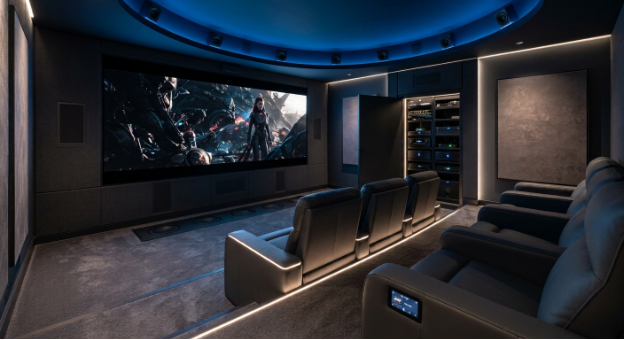
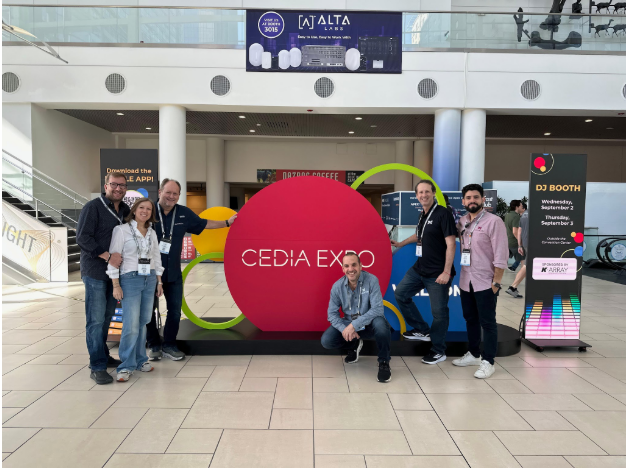
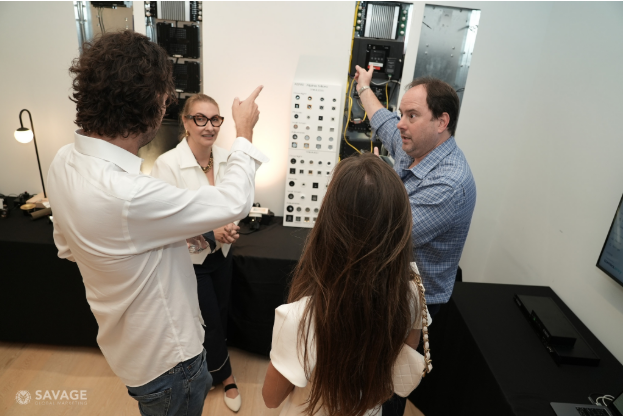
The residential entertainment industry is undergoing its most ambitious evolution yet. What we saw at CEDIA Expo 2026 in Denver made it clear that the traditional concept of a “dark room with a projector and visible speakers” is a thing of the past. Heading into 2027, high-end home theater setups focus on seamless architectural integration, AI-driven acoustic processing, and modular displays capable of overcoming any ambient lighting condition.
If you are planning or specifying a custom home cinema project, these are the key innovations in acoustics, display technology, and architecture set to define the coming year.
The Future of Displays: Modular MicroLED and RGB Laser Projection
The battle for giant-format displays in luxury residences reached a new milestone at CEDIA 2026, splitting the market into two high-impact solutions depending on the room’s environment:
- The Rise of MicroLED and Residential Video Walls: Large-format, self-emissive displays—such as Quantum XDR5-8K MicroLED systems or Just Video Walls’ Absolute Black solutions—are replacing projectors in multipurpose rooms and sunlit spaces. With bezel-free sizes exceeding 130 inches, absolute black levels, and extreme brightness, MicroLED delivers true cinema quality without requiring a pitch-black room.
- Pure RGB Laser Projectors and Acoustically Transparent Screens: For large-scale dedicated home theaters, projection remains king thanks to triple RGB laser light engines (like the Christie Griffyn 4K35-RGB or the JVC DLA-NZ900). The major trend for 2027 is pairing them with ultra-fine woven screens, such as the DreamScreen UltraWeave CoreX1, which eliminate moiré artifacts at 4K/8K resolutions while allowing front-channel sound to pass through with zero high-frequency loss.
- “Invisible” Tech in Living Spaces: For open-concept living areas, ultra-short-throw (UST) projectors concealed inside custom motorized cabinetry and gallery-style TVs (such as LG W6 Wallpaper panels or custom-framed Sony BRAVIA displays) allow the screen to vanish completely when not in use.
Next-Generation Acoustics: Active Calibration and Invisible Integration
On the audio front, the 2027 approach shifts away from raw power alone to prioritize seat-to-seat consistency and architectural aesthetics:
- Active Bass Control (WaveForming and Dirac ART): One of the most celebrated breakthroughs at CEDIA 2026 was the mainstream adoption of technologies like Trinnov WaveForming and Dirac Live Active Room Treatment (ART). Instead of relying solely on bulky passive bass traps that eat up valuable square footage, multiple subwoofers work in unison to actively cancel room modes, delivering tight, identical bass across every row of seating.
- Small-Aperture Architectural Speakers: Interior designers demand that audio equipment never compete with room decor. Product lines like Wisdom Audio’s iCS3FR series or Alcons Audio’s shallow-depth in-wall systems prove you can achieve full-range frequency response and reference-level sound pressure from minimal ceiling or wall openings.
- High-Density Immersive Spatial Audio: Configurations such as 13.8.6 channels—featuring point-source coaxial speakers for phase coherence—are becoming the gold standard for creating a truly realistic three-dimensional soundstage.
What Will the Ideal Home Theater Setup Look Like in 2027?
Next year’s ideal home cinema is no longer an isolated room, but an intelligent ecosystem where architecture, lighting, and audio-video operate under a single unified brain:
| Component | Ideal 2027 Specification |
| Display | Modular MicroLED display (115″ to 163″) for rooms with ambient light, or a pure RGB laser projector paired with a neutral-gain acoustically transparent screen in dedicated theaters. |
| Sound Architecture | Immersive layout (9.4.6 or higher) utilizing in-wall/in-ceiling architectural speakers concealed behind custom acoustic fabric panels. |
| Bass Management | Multi-subwoofer array digitally calibrated via WaveForming or Dirac ART to eliminate standing waves and room resonances. |
| Lighting & Shading | Dimmable architectural linear lighting (tunable white) integrated into ceiling/wall channels alongside whisper-quiet motorized shades. |
| Automation | Centralized control ecosystem (Lutron HomeWorks, Crestron, or Savant) featuring one-touch scenes that adjust lighting, climate, audio, and video simultaneously. |
The Key to Success: Engineering from the Blueprint Phase
The biggest takeaway from CEDIA 2026 for architects, interior designers, and homeowners is that cutting-edge technology demands early planning. Integrating linear lighting channels, structural pre-wiring, acoustic isolation, and thermal management for high-performance gear requires bringing a specialized systems integrator on board right from the architectural design phase. Ready to take your residential project to the next level? Contact the integration and design specialists at Maxicon USA to engineer a bespoke home theater setup where refined aesthetics and cinema-grade performance work in seamless harmony.